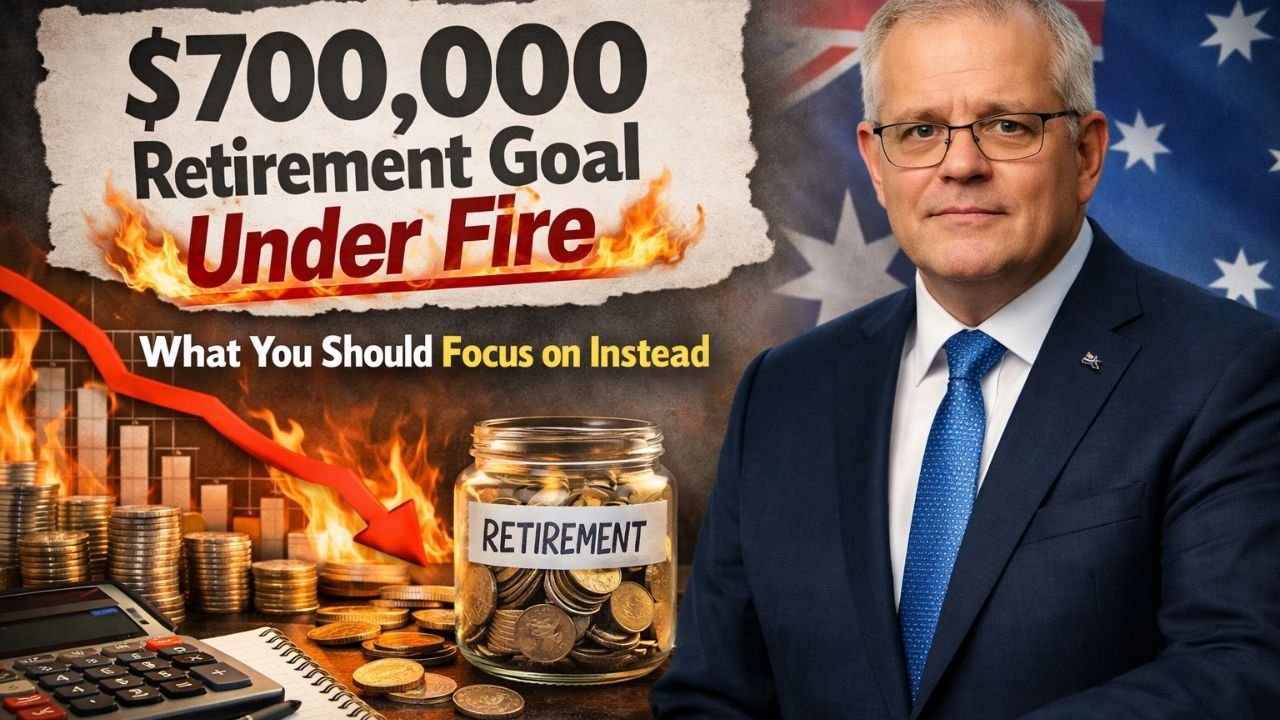
Financial planners and online calculators have been stamping a “magic number” for years, and for most, the number is around $700,000 for 2026. Most people see the number and think if they make that number, they can retire and spend the rest of their days on a beach with a drink in their hand. However, closer examinations reveal many flaws with that number, and they are more glaring with each passing year. The number does not change to take into account modern inflation, the rapidly increasing prices of certain medical services, and the most obvious, people live significantly longer today than they did a few decades ago. Certainty in a number can create false confidence or cause anxiety, depending on the situation. What most people consider “successful” retirements is most people actually not seeing the finish line and more clearly seeing the fluidity of their cash and their choices.
Moving Your Focus From Total Assets to Sustainable Income Streams.
Instead of thinking about their total portfolio balance, pre-retirees should be thinking more about reliable monthly income. A nest egg of $700,000 may sound like a lot; however, it does not really matter how much it is qhen factoring in interest rates and market conditions at the time of retirement. Instead, try to create a portfolio in which the capital is less important than the income. This means controlling how and when you collect Social Security, buying a fixed annuity, and keeping a rental property. Looking at retirement in terms of income replacement vs thinking about the assets you will have when you retire really takes the pressure off of being able to reach a certain number in your portfolio. Rather than focusing on a brokerage statement, you have to focus on the amount of income you generate which is a much more reasonable way to estimate your purchasing power.
Lifestyle Inflation and Geographic Arbitrage
A reason we will often miss our $700,000 goal is because we do not understand how much variation there is based on where you live, the money you have can live on much more in the middle or southern part of the country than on the coasts where you have at best, a pretty average lifestyle and pay a lot more in taxes. Instead of working harder to just attain a higher target number, a lot of people are finding more value in simply changing their “burn rate” to simplify their pathway to freedom. This is to say that by having a mortgage on your main house and downsizing before you retire (as your fixed costs will be decreased substantially), your are permanently increasing your level of freedom. Knowledge of your personal inflation rate (which is a function of your leisure activities, travel, and where you live) is much more useful than trying to understand an average number from a country that is not you.
Retirement Readiness Comparison
| Strategy Focus | Traditional Goal ($700k) | Modern Cash-Flow Approach |
| Primary Metric | Total Portfolio Balance | Monthly Net Income |
| Market Risk | High (Sequence of Returns) | Buffered by Guaranteed Tiers |
| Flexibility | Rigid Savings Targets | Adaptive Lifestyle Choices |
| Inflation Guard | Assumed 3% Growth | Dynamic Withdrawal Rates |
| Success Factor | Hitting the Number | Maintaining Purchasing Power |
Protecting Wealth with Health and Insurance
In 2026, the biggest problem for a $700,000 retirement fund will not be a market collapse; it will be a collapse of the healthcare system. Medical costs and inflation exceed normal inflation and the costs of long-term care can consume a mid-sized nest egg in just a few years. To create a financial buffer from the future healthcare chaos, invest in your health now (to reduce future costs) and consider purchasing Long-Term Care Insurance or a Hybrid Life Insurance plan. Don’t forget the “longevity risk” (the risk of outliving your money). Health Savings Accounts (HSAs) can be a great tool for late life needs as they provide tax-free growth for health expenses. Just be sure to keep the balance for health expenses only, as it will provide a safety net outside of your retirement fund.
Accepting the Semi-Retirement and Phase-Out Model
Ending your working life by going from 40 hours one week to 0 hours the next week is out of date. More and more people finding successful ways to retire are doing it as a phased process and going for what is called “soft retirement.” By doing part-time work or consult in your field for a few years after your target date, you leave your principal investment intact for a few more years to continue growing. It is a game changer for the stress on a $700,000 portfolio. Even a small amount of additional income is enough to meet essential living expenses and your portfolio becomes a travel and emergency fund. Seeing work as a transition rather than as a quitting process creates a feeling of social connection, purpose, and emotional well-being that is essential for a healthy retirement.
Changing Your Financial Outlook Outside The Spreadsheet
Focusing on the $700,000 target goal exemplifies that the world of personal finance is personal. The reasoning behind this is that the numbers on the screen are merely the mechanisms that illustrate the kind of life you want to lead. If you are about to fully retire and you are stressing about the memories you are losing because there is a $50,000 or $100,000 gap against your goal, your priorities are skewed. When it comes to retirement, it is about letting go of the math because you are not planning to eventually die. Focus on eliminating your debt, get your health care, and identify what truly brings you joy. When you establish these main pillars along your journey, the size of your nest egg becomes less important than the strength of all your retirement plans and the joy of the retirement years.
FAQs
Q1 Is $700,000 enough to retire on in 2026?
It all depends on the region you live in and how you budget your retirement savings The amount is enough in a low budget area, but in a metropolitan area, this requires careful planning.
Q2 What is the 4 percent rule and does it still work?
According to the rule, in the first year when you withdraw from your portfolio, you should take out 4 percent of it, and then adjust for inflation each year. Because of the impending market instability, experts believe it is best to withdraw only 3.3 percent to 3.5 percent so that the money lasts 30 years.
Q3 What is the biggest hidden cost in retirement?
The biggest hidden costs are in health care and long-term care. Most retirees are underestimating the out-of-pocket costs over a lifetime that may not be covered by Medicare, which are likely to be hundreds of thousands.