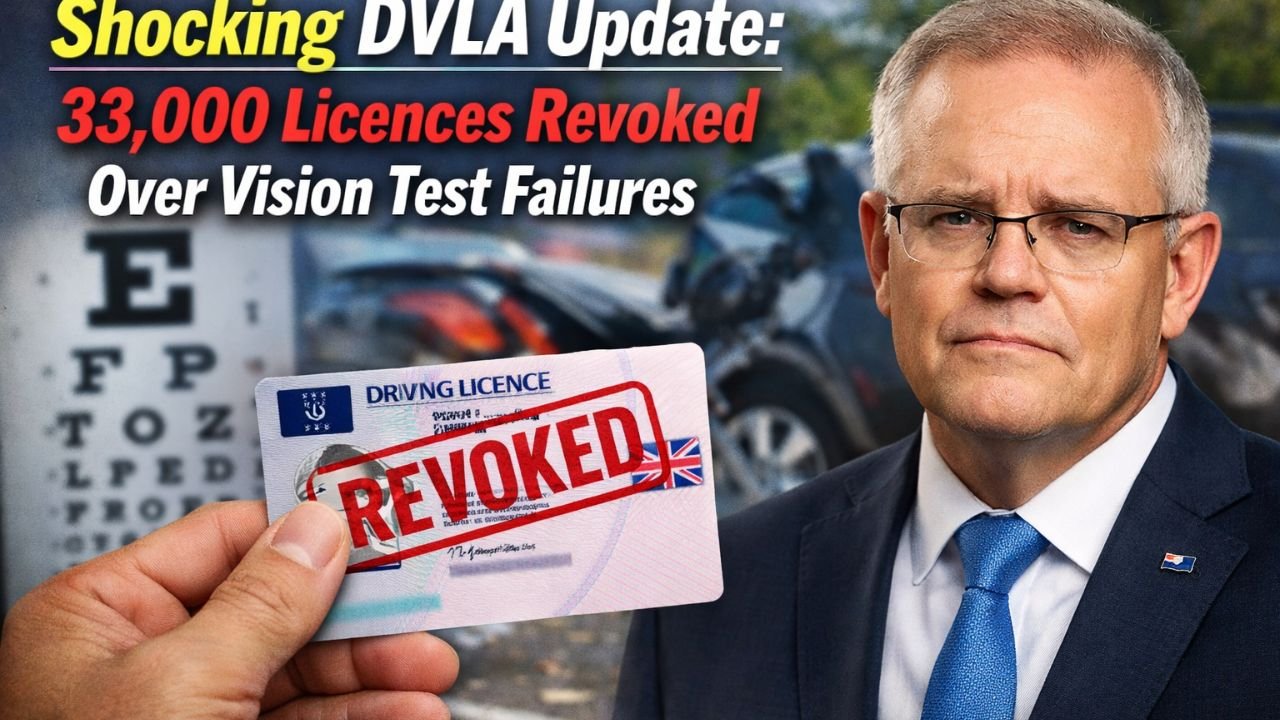
New reports from the Driver and Vehicle Licensing Agency (DVLA) continue to raise concern among the UK driving community. The most alarming reports highlight the total absence of regulation regarding health and road safety. Over a four-year span, nearly 33,000 driving licenses were revoked or refused. This number was retrieved from a data set made public through an information request. This data represents one of a myriad of different ways the DVLA strives to remove “high-risk” drivers on the road. The average driver sees the “health” portion of their driving record as a formality; however, the DVLA health standard test is a mandatory requirement. The DVLA is attempting to remove people from the road that pose an even greater risk than visual impairments and include: untreated cataracts, and myriad more complicated neurological conditions.
What Drivers Need to Legally See
In the UK, to be legally able to drive, one needs to be able to see a regular vehicle’s number plate from a distance of 20 metres. This is the most practical, “real-world” assessment done during a police stop or by the examiner at the beginning of a practical driving test. In addition to this distance check, drivers are required to have a minimum visual acuity of 0.5 (6/12) on the Snellen scale and are obliged to wear corrective lenses, if required. In addition, a person’s overall visual field must be large enough to detect a cyclist, pedestrian or a developing risk. Additional visual requirements are needed if the driver is a professional one, as in, driving a heavy is considered a good’s vehicle (HGV) or a bus. Recent statistics show the driver’s licenses have been revoked and it appears that many drivers do not understand the specifics. Many drivers do not consider the gradual decline in their vision that occurs naturally with age.
Statistical Breakdown for Average Age of License Revocation
The extent to which vision-related revocations has affected the population as a whole is not the same for all age groups. Data shows older drivers are affected the most. This is because age-related eye diseases such as glaucoma, macular degeneration, and diabetic retinopathy are more common in this group. Of all age groups, those in their 70s and 80s had the most cancellations between 2022 and early 2026. These findings have caused the government to consider more serious options in law reform, such as implementing mandatory vision tests for drivers older than 70 at three-year intervals when renewing their driver’s licenses. Below is the breakdown of the age groups affected by these vision-related enforcement actions:
| Age Group | Number of Licences Revoked/Refused | Primary Risk Factors |
| 40 – 69 Years | ~12,888 | Professional fatigue, early-onset cataracts |
| 70 – 79 Years | 10,794 | Glaucoma, declining night vision |
| 80 – 89 Years | 8,060 | Macular degeneration, slower reaction times |
| 90+ Years | 1,202 | Severe visual field loss, cognitive decline |
Not Disclosing Certain Medical Conditions have Consequences
The DVLA’s response to not disclose certain notifiable medical conditions has a drastic effect on drivers in the UK. Almost 200 conditions can affect your ability to drive safely, and vision problems are the most serious.
If a driver’s been put on a medical hold with a diagnosis for a condition that impairs both eyes (or one remaining eye if they are monocular) they must report this to the agency as a matter of law. This doesn’t refer to ordinary short-sightedness or colour blindness. However, if the driver’s condition is in the category of double vision (diplopia), night blindness, or retinitis pigmentosa, the driver must report their condition. Not reporting is not just a matter of regulation non-compliance, in fact it is a criminal matter with a maximum penalty of £1,000. More importantly, if you are in an accident, and it is brought to light that you have an unreported medical condition that you should have reported, then your car insurance is not going to cover you, and you will be responsible for the accident.
Roadside Enforcement and “Cassie’s Law” Power
The DVLA cannot enforce things by themselves and rely on the police to take action. Incorporating the “Cassie’s Law” (named after Cassie McCord, who was killed by an 87-year-old driver who was previously cited for an unfit vision test), police can request the emergency suspension of someone’s driving privileges. If a driver is caught on a roadside plate scan, the police can submit an electronic notification to the DVLA, and the driver’s license can be taken away within a few hours. This system is used to stop drivers from continuing their trip who are known to be unfit to drive due to poor vision. As we approach 2026, the government is implementing more vision tests, and road safety advocates are suggesting that driver’s licenses should be tested by a doctor’s office every ten years to align with the picture card renewals. This change is “gradual” in the hope to prevent a death or injury caused by someone driving who is slowly losing their sight.
Keeping Your Vision and Your Freedom
Many people see losing their driving license as losing their freedom. However, the DVLA says that you can have a medical diagnosis and still not have a driving ban that lasts forever. Sometimes, the agency can issue a “medical license” for a driving period of one, two, or three years and the license is subject to constant reviews. Some people may just need to modify their cars, or make sure they have the correct glasses or contacts. Managing your driving license is the most important part. For example, you have to see the eye doctor every two years at the least. Newer technologies for cataracts and glaucoma can help you see well enough to drive legally again. Keeping your eyes and vision healthy, can help you continue driving for the rest of your life.
FAQs
Q1 How far back do I need to be able to see a license plate to be able to legally drive?
You need to be able to see a license plate at a distance of 20 meters (about 5 cars) and in good lighting, and you need to be using your glasses or contacts if you need them.
Q2 What happens if I fail an eyesight test conducted by the DVLA?
If you fail to meet the minimum eyesight test standards established by the DVLA’s contractors, you will lose your license. Once you are able to provide a medical report to the DVLA showing your eyesight has improved enough to meet the standards, you will be able to reapply for your license.
Q3 Do I need to tell the DVLA if I have had laser eye surgery?
Usually, no. If your eye surgery does not result in a complication that affects your vision, and even more so if it does not help you meet the legal eyesight requirements regarding the number plate, you don’t need to tell the DVLA.